Showing posts with label Learning. Show all posts

Monday, 13 April 2020

Isolation 6

Thursday 9 Apr
Had a busy day doing a lot of school related work but still managed to make hot cross buns. I got the green bin filled with garden rubbish and got them out so at least I realised it was Thursday. I really didn't feel like being in front of a computer in the evening so didn't even get to write this on Thursday! I didn't do my MIE blog and I didn't manage to do much else . I think it is good to be able to tell myself that it is OK to not be at 100% at the moment.
Going for a walk today I took  this photo - just shows that the social distancing is working - here is the second path that people are taking to keep away from others. Good to see it does work! I saw a guy I went to school with today and stopped to talk to him and his wife. We were all talking about how strange this all is and where things might end up eventually. It certainly is an interesting time. Writing this blog is my journal really as to what it's been like - will look back on it one day and have a read. I wonder what it would be like to go back to the earthquakes if I had been writing then? I know I was quite obsessed with the data - I still have the quakelive pictures (I printed them out) somewhere. I also struggled hugely in many ways. Hmmm, might have to write something about the similarities and differences....
Friday 10 Apr
Good Friday. I am sure many people wanted to go away at Easter and some have even tried. I can't believe how people will not stay home. It is really crazy. Had a really lazy day today. Played Talisman most of the day, with a break for jigsaw and a walk. Early evening saw a fence party going on - a couple of the neighbours and I had a chat - at a distance. It was nice to chat though. Even though we can talk to people online it's not the same as being face to face. Once again I didn't get much done and didn't feel like doing much, maybe this last two days has been my weekend. My head is certainly not in the best space right now, so I'll just let it flag for a bit and not worry too much. Hard though as I am normally quite busy and productive. Hmm, week 3 of lockdown might be getting to me a bit.

Saturday 11 Apr
I got very motivated to bake this morning - made more hot cross buns and a lemon cake as well as cooking breakfast for all of us this morning. I watched a couple of interviews on YouTube about education and then went for a walk again. Played Talisman for the afternoon really and then cooked dinner and went to bed early. Another day of not doing much work or reading. Have to keep telling myself it's OK. I am managing to do some things for myself which has to be a positive thing. I did hear about a new vege place today in the north of Chch and have ordered some from there (The Mad Acre ) to try them out this week. I'll let you all know how it goes!


Sunday 12 Apr
Certainly feel a bit more like doing things today. It's been a funny few days with me being very unmotivated and although I have achieved some things, I certainly haven't done as much as I wanted to. Finished Wasjig8 this morning - that was good, taken me a few extra days but my children haven't been helping as much with this one. I am enjoying just sitting putting a few pieces in each morning. I'm very organised when it comes to jigsaws - I sort all the pieces into colours and shapes, makes it a lot easier, especially when you don't have a picture to work too like these.
Watched a Youtube clip today on online learning in China. Fascinating to listen to world views on education and how we have the opportunity to do things differently for education. This group has a website for Silver Lining for Learning and it has info about their other discussions. It was good to hear about what they did in China - one thing standing out to me, we don't have to do everything online - paper is fine! They also shared a lot of resources city wide - teachers sharing everything for any school. They also made everything individualised, providing tutors for those that needed support. I also read this blog about Non digital Remote Learning - something we need to consider for many of our ākonga. I like some of the links from here as well.
Had a good chat with a friend today which made me think about the similarities and differences again of the earthquakes and the current situation. I think I'll write a separate blog about this as I find it quite interesting. The evening saw a catch up of our dragonboat team online - good to see those smiling faces ad find out what people have been up to. You do realise how much you miss something once it's not there and even though i don't always do the social thing with the team, I do miss that contact each week.

Monday 13 Apr
Definitely more motivated today. Out in the garden early and have made worcester sauce today. Funny how moods can change so quickly with each day. Some days y brain is working fine and others it is not. I've started the next jigsaw and have been finishing a bit of work as well. Far more productive!
Hmm, was going to write more about today but a friend has sent me a text to say her Mum died this morning. I'm sad. I can't imagine how horrible it would be to be in that situation right now. I have no words.
Posting this - it's time, and I'll think and write better tomorrow.

Friday, 13 July 2018

Future of Learning Masterclass

So after an amazing day of talks by inspiring people, we got the chance to dig a little deeper and look at how we could change things in education. The Masterclass was run in two groups - Youth and Adult. The youth group were Year 7-10 students from around Christchurch and the adults were from a range of places around New Zealand and overseas, representing schools and businesses. These are my notes from the combined sessions we had. From this we have a small group working on an exciting venture which hopefully you will hear more about later in the year!!

Tuesday Session 1: Jason Swanson
How might we transform learning to meet the challenges of the future?


Every student should experience learner-centered education so they are ready for what's next.
Group agreements: Have diverse ideas and perspectives. Stretch past your comfort zone. Participate fully. Step up and step back, listen to others.

Think about one skill or attribute you rely on today that wasn't valued or taught in school.
Standing up for what is right
Learn to speak out
Positivity
Confidence
Life skills and social skills
Future focused curriculum
How to study, best way to gain knowledge
Problem solve from different perspectives
Having a rich inner thinking life. Space between conversations
Being collaborative
Being yourself

Into the future :
The future is not a fixed point, it is ours to create. The future rarely arrives unannounced, there are trends that give us an awareness.
What happens if...
Change doesn't just happen to us, we interpret it differently.

Framing, transform learning
Scanning, trends and patterns

Futuring, create images of the future
Visioning, what do I want out of it
Designing, think of ways we can create artists that achieve the vision.  Adaptable, How to create plans that are flexible and adaptable
Cone of plausibility
The further into the future the more variables there are. Think of lots of scenarios.
3 types of future: Possible, Probable-narrows it down a bit, Preferable-vision area
Framework for how they come up with forecasts (more info at https://knowledgeworks.org)


People change at a faster pace than structures. Society changes slowest.
Parents reluctance to change education because it is what they know.
Provocation, how could education change
 Partners in code.
Era shift. Major change from one era to another. New ways of interacting, new economic models, expenditure advances in tech that move us into a whole new way of thinking and doing.
There are things we take for granted that are quite new. GPS, YouTube
We live in an exponential world but education seems to be resistant to change.

Drivers of change :
Optimised selves. Understanding of our bodies, fitbit, pedometer. Through tech we can monitor performance and get feedback. Can we begin to harness wearables etc to design learning?
Alternate economies: how do we find where we got in a world of choice? Finding the right niche. Student debt, under employment force us into different work. Need for education to help quid epistle into the right fit. Personalised learning, how do you prepare someone for a career that could be very different.
Labour relations 2.0:
How do we negotiate new machine partnerships? How do we prepare students for a new world of work.
Smart transactional models:
Have increased transparency. How are decisions being made. Diversifying structures and rules.
Blockchain digital ledger model. Resource sharing
Could we use block chain and smart contracts?
Shifting landscapes : navigating complexity. All about change. Have to put strategies in place to navigate change. Schools get teams to solve community problems. Perhaps learning is organised as ecosystems. Sharing of resources and expertise
Equity is not a given. It is a key design challenge. When we redesign education it has to be a key feature.
Walls of the classroom have to become increasingly porous.
Best time to be a learner but maybe not the best time to be a student.
How can we educate the whole person?

How can we balance the learning and the community tension?
How can we create flexible approaches?
How do we define equity?

What about these changes seem exciting?
Being part of the change
Choice and personalisation
Robots can be useful
More coding jobs
Wouldn't it be awesome if we worked like this with adults and children together
What seems challenging? 
The spaces
How
Robots taking over. Need teachers to empathise.
Getting communities on board
Job uncertainty. Will uni credentials be valued anymore?
What new questions and insights come up?
Passion and pathways important

Mood meter on wall - we got to put sticky notes on how we felt to see the overall mood of the group

Tuesday Session 2 - Adults

This session was about analysing strategies to create change

We had 5 large sheets of paper around the room with the following topics in the middle:  Personalised PD, New Assessment and Credentialling models, Educator Roles, Technology for Agency, Partnerships
We then had to start unpacking this as to what it could look like in the future. Jason challenged us to do "headline type" statements and keep working out from each statement. We could move around the groups or stay in one. After that we then had to choose one of the statements and list the challenges and opportunities that it could bring. 

I really enjoyed this way of looking at pros and cons of ideas.


Jason talked about the Generative Thinking Model and explained that we would be using this Design Process model to work on a strategy

So we were given 5 questions:
How might we:
Balance personalised learning and collective need?
Solve real world problems as curriculum?
Encourage collaboration across diverse roles?
Use AI/Machine learning/automation to free up teacher/staff/employee time?
Address issues of technology access?

We each chose a question that we felt we wanted to work on (we could change if we wanted) - I chose the first question
The rules were:
Let go of your agenda
Listen in order to receive, active listening and pay full attention
Build on what you receive
2 ears one mouth, proportional to its importance
Make your partner look brilliant
You can't be wrong
Keep moving forward

Opportunity:
What are the users insights?
Talk to users and experts to clarify the questions. We are all users.
We then had a "Discovery conversation" with one of the experts in the room - our group had Hamish Duff to question.
E.g What was an experience or situation that you felt was uniquely tailored to you?
Questions, tell me about a time when...
How would you define...
Watch body language. Dig deeper
We wrote a max of 5 words on sticky notes that captured what we heard/saw rather than what we thought.

Then we shared and put the sticky notes on large paper and clustered them into broad categories that we labelled to identify the insights from the user to hopefully help solve our problem. We then looked at how to reframe the question, if needed.
Our question was reframed to "How might we weave personalised learning and collective need?"

Design
The next step was to brainstorm solutions.
Cluster and label your solutions, adding, revising and synthesising them
Which solutions are most innovative?
Which would have the most impact on the design challenge?
Vote on the one that is most compelling

At one stage in this process, Cheryl came over with a book - "Non-Obvious 2018 Edition: How To Predict Trends And Win The Future" by Rohit Bhargava with a chapter on Lightspeed Learning which fed into one of our ideas. 

The rest of the day was spent unpacking our solutions and ideas.

Wednesday - Session 1 - Technology

The first session was an opportunity to explore some technology and talk with experts about how we might be able to solve our problems.
There were VR units, robots, all sorts of toys to play with as well as some amazing people to talk to that work in this industry. 
I was hesitant about the Windows Mixed Reality desktop but as I got into it, I could see a lot of potential uses. Our world is going to change and we are going to have to keep up!!

Session 2 - Pitching our idea - EricaAustin - E. A.Curation 

Erica came to teach us how to pitch our idea to others.
She got us to pitch about an item we knew well (phone, laptop, pen) to a small group for 30secs, then 20 then 10 - keeping it succinct and exciting! Small amount of time to grab attention
Impact and how you are benefiting the community.
What is your uniqueness?
What makes a good pitch? Performance, passion, taking audience on a journey, good use of format, simple to follow, relationship to audience and space, comfortable and confident.
Doesn't matter if you mess up, part of your performance
Passion, time to show off. Pitch yourself as well as the idea.
Storytelling - take the audience on a journey to evoke an emotional response, create characters and follow them through the pitch.
Pick one or two people to pitch. It takes time to adjust to different people so don't want too many
Easy transitions between slides. Slides there to support.
Holding phone? Notes?
Learn the beginning and end but can refer to notes inbetween
Pause for people to think
Format: Who are you? Problem you are solving. Your solution. Who is the customer? Why are you unique? What are you asking for? Maybe you can partner with someone. Have to ask one thing, come to an event, support us in that idea, give more info.

Time frames, could switch around components. Work out time slots
Relationship with audience and space. Get a feel of the space, could be spotlight, stage, where are judges sitting.
Talk like you are friends with the audience
What are you wearing
Know your lines. Memorise start and end, notes in middle
Practice:
Video yourself and feedback. Practice in front of people. Time your pitch. Try to do it in half.
Slides:
Don't use comic sans or times
Don't go over margins
Keep it central for quotes
Power of pauses. Let them read quote
Branding, don't need on every slide, maybe use just colour or part.
Use simple graphics
One image with one word.
Get slides to help illustrate a point.
Unsplash.com high quality images

Session 3 

Prototype
We then spent some time on our Prototype solution and what it might look like.
We then pitched this to another group and got feedback.
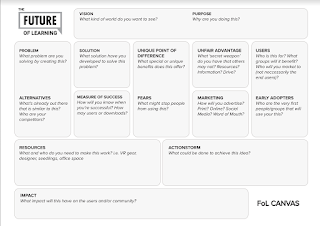
We completed a Future of Learning Canvas which was a fantastic was of getting all the detail in one place.

Impact
The last session was on impact
What is it we made and whose lives would it change?
What human need is being addressed and how are we addressing it?
What kind of impact are we hoping to create?
How will people engage with it?
What are the next steps?
We put all the ideas of what had to be done next and put them on the Roadmap. Our group (Michael, Andrea, Gina, Liz and myself) are super keen to keep working on our idea and have organised ourselves a Slack channel to keep working on this. We are also going to meet up face to face (and Skype Michael in from USA perhaps!) in the near future.

We then pitched our idea to a few groups from both the Adult and Youth Masterclasses and heard theirs. Really amazing ideas and lots of potential.

I enjoyed the opportunity to work with people from other sectors, not just teachers but also with the youth who have a different perspective on what our future might be.
Thanks to Haeata for giving me this opportunity - I loved every minute of it and know that this will just be the beginning of more learning and collaborating. It's exciting.


Sunday, 1 April 2018

Lifelong Kindergarten

I have been reading quite a few books lately and thought I would share a few, as I have been moved by so many of them, and keep having the "yes!" moments. This is the first of a few that I had on my list to read. These are just notes and quotes of things I liked or found interesting, or maybe want to read more about, but hopefully it will give you a taste of what it is about and make you want to read it too!


Lifelong Kindergarten
by
Mitchel Resnick

You can purchase this through quite a few sites, and I certainly do not regret it! The website is here, so you can read more about him and his work. It also has a list of further reading which looks great!


At a conference his nomination for the best invention of the last 1000 years was kindergarten. Only 200 years ago it was very different from traditional schooling. Froebel invented this approach knowing that the broadcast approach wouldn't work for 5yr olds.
Kesnick is convinced that "kindergarten-style learning is exactly what is needed to help people of all ages develop the creative capacities needed to thrive in today's rapidly changing society."
He discusses Froebels approach and the troubling trend of more and more kindergartens doing math worksheets and phonics becoming more like school. He argues for the opposite that school should become like kindergarten.
He thinks of the creative learning process in terms of a creative learning spiral pg 11 and discusses how this works.
One of the recurring themes in the book is the Scratch community. He is a founder of Scratch and uses it often as an example of the type of learning he is talking about.
The development of Scratch has been fixed by the 4Ps of creative learning...
Projects
Passion
Peers
Play
Some discussion around the difference between techno-enthusiasts and the techno-skeptics. Is interesting with him looking at pro and con of both, agreeing and disagreeing with both as well and giving some interesting points to think about. I like "people tend to forget that crayons and water colours were voted as 'advanced technologies' at some point in the past".

The next chapters go into more depth on the 4Ps.
Projects get a lot of information about the maker movement and he discusses the learning that is had from making, in particular with Lego and logo, computer program for Lego. This is a link to the foundation with lots of resources on as well. He also goes through how project based learning teaches students concepts in meaningful contexts rather than in disconnected problems in more traditional learning.
Passion chapter talks a lot about Computer Clubhouse and the students who would go there after school for hours and being engaged with learning and being creative.
"passion is the fuel that drives the immersion-reflection cycle"
This is for all ages, from small projects to a thesis, if you are not passionate about it, you won't persist and persevere through the challenges you come across.
There is a section on gamification and badges, the effect of giving rewards being negative when creativity is involved, the lure of reward or payment makes the focus and doesn't allow for creativity, just an end product.
"if your goal is to train someone to perform a specific task at a specific time, then gamification can be an effective strategy... But if your goal is to help people develop a life long learners, then different strategies are needed."
His views on personalised learning are aimed at giving the learner choice and control over their learning.
Mentions Karen Brennan exploring the relationship between structure and learner agency. Difference between an online Scratch community which has lots of agency and little structure, they can create what they want, to school classrooms usually with lots of structure and little student agency. She argues that the best learning environment would be one that "employ structure in a way that amplifies learner agency"
Peers - Design of the space is important if you want peers to work together. Small clusters of computers, tables to sit and discuss ideas and room to move around are important as well as sample project ideas and the place for them to get ideas from. Priority being that they choose who to work with on same passions.
A big influence on Resnick s work is Seymour Papert's book Mindstorms which talks about Brazilian samba schools where they go to create music and dance for festivals. It is interesting to read how he talks this idea and has used it in the design of Scratch. I read a sort of translation of Mindstorms which was quite interesting, you can read it here.

Openness is talked about, sharing with others and remixing projects. This can also lead to controversy and has done so in the Scratch environment where their policy is that all projects are covered by a Creative Commons Attribution license which means you can change anything as long as you give credit.
We have been brought up in schools to always do our own work but that's not how the scientific community works, they share ideas and build on what others have done. We don't teach that.
The Scratch community has a strong culture of care and has guidelines to encourage this. They are told to be respectful, constructive, honest and help keep the site friendly. They unpack these for all members.
There is a good section on the lessons they have learnt around having this open and sharing community with both the pitfalls and the successes.
There is a section on teaching and how they train their mentors for the Codeclub. Often teachers do one of two things, deliver information and instruction or leave children to do it themselves, neither of which works.
Computer Clubhouses try and blur the lines between teaching and learning. They teach their students to "serve as catalysts, consultants, connectors and collaborators within the community, helping others to learn while continuing their own learning."

Hole in the wall experiment by Sugata Mitra - wonder when learners need support and guidance?

" Play doesn't require open spaces or expensive toys; it requires a combination of curiosity, imagination and experimentation "
Playfulness:
Playpen vs playground
Playpen environment with limited options and a lack of risk and creative opportunities.
Playground they have room to move. They can work with others and be creative. Lego is playpen when following instructions to build something. Can be great to gain expertise in building and learning new techniques but if you want creativity step by step instructions then it should be the beginning of something, not the final destination.
He talks about tinkering being between playing and making. People tinker around and make mistakes and try new things. Making prototypes and testing and trying again. A great way to develop creative thinking.

Dennie Wolf and Howard Gardner identified two main styles of play, patterners and dramatists. Patterners love patterns and structure and will play with blocks and puzzles, dramatists love the story and social interaction, more likely to play with dolls and animals.

Wellesleyrobotic design studio more suited for dramatists, MIT robot design comp for patterners. Need to have both styles. Some are planners , some tinkerers. Some take more time than others. Need experience in all styles as some are more use than others in various situations.

KenRobinson emphasises the importance of making mistakes. Coding is an easy place to do that. Debugging helps that process and there is more than one way to get an answer.
He talks about how to assess creativity and how schools tend to focus on things they can measure rather than the things that will make a difference in kids lives.
Reggioclassroom always making learning visible.

Ten tips for learners, based on a list made by students and then he has added comments:
  • Start simple
  • Work on things that you like
  • If you have no clue what to do, fiddle around
  • Don't be afraid to experiment -I like the comment on here that is useful to be able to follow instructions but if you only ever do that you will get stuck when you come across something new that has no instructions
  • Find a friend to work with and share ideas
  • It's ok to copy stuff to give you an idea
  • Keep your ideas in a sketchbook
  • Build, take apart, rebuild
  • Lots of things can go wrong, stick with it
  • Create your own learning tips


Ten tips for parents and teachers
Based on his creative spiral he gives 2 tips for each component.
I really like the idea of extending project time where they can work for weeks on projects in school.

Ten tips for designers and developers who want to engage children in this sort of learning. He talks about the difference from deliver to enable, low floors, high ceilings and wide walls.

Good final section is about how we can break the barriers to enable lifelong kindergarten.
There is also a great further reading section.

Wow - I was very inspired by a lot of this and want to read more, and do more. Very keen to learn more about the Computer Clubhouse (there are 3 in New Zealand...) and read all the articles on the links I've put in. Lots to do....