Showing posts with label @ChristchurchAirport. Show all posts

Monday, 5 October 2020

Boma Workshop - September

 Our last full day workshop was held at the beginning of the school holidays. The year seems to have gone so quickly and I still have so much to do on my project. My goal for the day was to get another page complete on my website and to get more feedback on what I have been doing.

My project has come out of my passions for all learners being able to be catered for in a classroom, and to help support kaiako to do this. As kaiako we are time poor and often just wish that there was a simple way to get access to information rather than troll through a million websites and read a ton of information, most of which is not relevant. My goal is eventually to turn this project into a VR/AR app that people can use to experience what it is like to be neurodiverse, but also to have overlays to show how things can be changed easily to make a difference. As that was a fairly full on project, I cut back to a website to start with, to get some ideas down and to start on this path. Interestingly enough, my new job (Learning Support Coordinator at Papanui High School) slots right into this project so I will be keen to flesh it out more once I am there. Meanwhile I am giving those of you that read my blog the opportunity to have a look at the work in progress and if you can find  a bit of time, I'd love some feedback

We had a short workshop on the inner critic today. I loved this poem that was read to us at the beginning:

Our Greatest Fear —Marianne Williamson

Our deepest fear is not that we are inadequate.

Our deepest fear is that we are powerful beyond measure.

It is our light not our darkness that most frightens us.

We ask ourselves, who am I to be brilliant, gorgeous,
talented and fabulous?

Actually, who are you not to be?

You are a child of God.

Your playing small does not serve the world.

There's nothing enlightened about shrinking so that other

people won't feel insecure around you.

We were born to make manifest the glory of
God that is within us.

It's not just in some of us; it's in everyone.

And as we let our own light shine,
we unconsciously give other people
permission to do the same.

As we are liberated from our own fear,
Our presence automatically liberates others.

The inner critic in us often stops us from being the best that we can. It also feeds into the imposter syndrome. This is where you feel like you are not qualified enough or not worthy of what you are doing. Many famous people have spoken out about it, including Meryl Streep who said "Why would anyone want to see me again in a movie?" You can read a bit more in this article about how to overcome imposter syndrome

Fear doesn't go away but it can hold us back from what we could do. This safety mechanism is great when we are in danger, but not so good when we are not. We still need to take risks and make change without being guided by this inner critic. 

So what can we do to help conquer this? We can notice and label it first. Know that the little voice is just that, just a voice. Say that "my inner critic says I can't do it" rather than saying you personally say you can't do it. Be compassionate - your inner critic is trying to keep you safe, just say thanks to it but do what you want anyway. Remove the inner critic from the scene. I believe I have boxes, like compartments in my brain, so I would put it in one of those - and shut the lid. We want to be able to tap into our inner mentor - the older, wiser version of the critic and grow into this version. 

We had some good discussion around what our inner critic said to us and what we could achieve if we didn't listen to it. We mustn't let our inner critic hold us back from doing the amazing things we are capable of.

The rest of the day was dedicated to doing work on our projects and getting feedback. We had a group of last years Boma Fellows in during the afternoon as well as some of the Christchurch Airport staff.  I changed quite a lot of things as the day went on and have been working hard this week to get it to a state that I feel I can send out. There are so many other things I want to add eventually but have to keep it simple for now. I did appreciate all of the feedback though and it certainly made me think about how things look and what is really needed. Hopefully with more feedback and time it will just keep getting better and better.

My goals before our next meetup:

Complete the website for feedback (tick)

Re do and refocus my pitch - we have a presentation in November, that's not far away now.

Get feedback (write a feedback form - tick) and adjust my site


Looking forward to the next meeting in a couple of weeks!


Wednesday, 8 July 2020

Boma Accelerator Day 2

Up early for a walk around Lake Tekapo - beautiful day and nice to go to the Church of the Good Shepherd and the Sheepdog Memorial without anyone else there. The joy of getting up early.
Our first job this morning was to do our timetable for the next 2 days. We started by working out what we wanted completed by the end of the two days, then worked backwards form there to put specific things on the list.

Mine:
Tues am
Update the Canvas and planning docs on our Boma drive
Show Kit what I have so far - test and iterate and test....
Work on my website so I can get a bit more of the MVP done especially the front page
Tuesday lunch
Finish the first website page
Do another test and iterate
Work on my pitch for this afternoon
Tues pm
Practice pitch
Write blog and process talks from today

Wed am
Complete 2 blogs
refine my pitch
Continue with site after more iteration

Wed lunch
Have a pitch done and rehearsed
Have a website 2 pages OK ish - iterate 2 or 3 times
Have 2 blogs up
Show to some of the others here to get feedback

We had to put a smiley face on for any 5 min job - I didn't really have any but others were then instructed to do the 5 min job now.

I got feedback from a range of people today which helped immensely. It was good to keep going back and getting more ideas.
 - need to add a good description, there is an assumption that people already know why they are here
 - add testimonials from people to add weight
 - make it clear, easy and fast to access
Put on someone's hat - Customer personas - 10 step framework - really great way of thinking about what we need to look at when making our products. We were given a couple of options and I am certainly going to use this to check what I am doing. Need to go through each of these to check what I need to think about.

Melissa Clark-Reynolds

@HoneyBeeGeek
We had a Zoom call with Melissa today. She had some amazing insights into the business world and talked us through her time with developing Minimonos which was a virtual reality world for kids.
Virtual worlds were really popular in the 2000s. Other generations had a real world, they could bus places, people knew each other, they had a lot of freedom. The new world is a lot smaller, they are not allowed to do so much. Parents track their children using phones and the world is seen as a dangerous place. They wanted to let kids know they could make a difference and wanted to give them somewhere they could build a habitat.
During the time when Minimonos were very popular they learnt about brand extension. They learnt to release on a Friday, they looked at where to next and there were a few choices - TV, Browser, Publications, Touch (tablet), Ethical merchandise, Toys and collectibles. They did cards on recyclable paper but found it hard to get into the ethical toys. Most kids liked to party - online they could find friends and community. Most wanted that social connection, a lot were really lonely but in the online world they had best friends. There were a wide range of ethnicities so they had 24hr activity. If kids turned up and no one was there they would leave and come back later. They had virtual costumes - dress up without the waste. Halloween is one of the larges causes of waste to landfill.
At Xmas 2012 the toy industry went into decline due to the introduction of iPad mini and kindle. Children stopped watching TV internationally and the TV ads were the best for Minimonos. Flash didn't work on a browser and they were on the tech list not the toy list. in Jan 2013 Nickolodeon was down 30% and they had lost their path to market and to the platform. Moshi Monsters, Club Penguin, Minimonos all were dropped at this time and Minecraft grew so much. They tried to pivot but were not fast enough.
Question is - when to pivot or when to quit?
Angry Birds made 51 losing games before they made Angry Birds, if they hadn't made that they would be over.
Lessons learnt:
Is the business model right? - they were right but not fast enough, the pricing was right but not sustainable. Now many do through sponsorship
Has the market shifted?
Has the tech moved? If it's not fit for a new shift, how do you do it?
Can the product get out?
Is there better use of capital and time?
Have you got the dream team?
Unfair advantage - they didn't have anything special, now they would probably have hired psychologists and use celebrities. Need an advantage
They closed in 2013 - there was a change.org campaign to reopen.
"Winners quit fast, quit often, and quit without guilt." Seth Godin 
At least you built something people will give a shit about.
"You can't learn less" If you commit to learning the lessons, that knowledge will never leave you. Need to understand business models from the get go.
Many online game companies closed over 2013-2017 - some were funded through sake of merchandise, but all plastic stuff. Filling the world with plastic is not going to help with anxiety
Club Penguin closed in 2017 - in 2016 they had a penguins of colour matter protest - children could have a voice, even if it was only with each other.
Minecraft - you get to create their own thing. Passiveness doesn't work
Greta Thunberg "Our house is on fire"
"Many of us often wonder what kind of planet we are leaving behind for our children but few asked the opposite: what kind of children are we leaving behind for our planet?"  Simeon Ogonda 
As adults, what are we doing to enable these children to make the difference they want to make?
One question asked - what are the homeless people doing when it snows? Good answer - what would you like to do? Taught that they can do something, not just saying "don't worry about it". Students now are anxious for a reason - pressure to stay safe, their world is very small. Daily bombarded with Covid19, Trump. If they weren't grieving they weren't paying attention. We need to take a step back and if we feel powerless, imagine what it feels like for them. Anxiety is an appropriate response for the world they live in. How can we give them agency?

Why is Minecraft successful? It looks like Lego, they have the power to make the environment what they want. Boys like jeopardy and potential risk - creepers give them that element. They like fear and risk in a controlled environment. Showing off is important, our society rewards extroverts - online introverts can be successful online extroverts by showing their work. Like a bit of moral superiority - their big brother can show them how to do things. Others are able to coach and be experts, they have agency over their own domain, can be experts in it. They love being an expert over their parents.
Different countries have different ideas about play. Some have play for play's sake. This generation is more tested than any other generation, they are always found wanting, even when they get 99%. We need joy and beauty and play. They don't have much free time and there is pressure form school, they are aware of the financial pressure on parents, need to create joy and play for play's sake. This reminded me of the Lifelong Kindergarten book (see my previous blog on this). Singapore only has play type activities if they are enriching - has to teach them something, maths, science etc.
Assumptions, adults designing for kids, we mean well. Gen Z is more community minded and philanthropic. School strikes, climate marches, almost back to the hippie days but without the drugs and free love, more serious but also in more pain. Dystopian fiction is so big. Need "hopeful sci fi". Can we show them solutions to things? Where are the platforms that showcase these solutions? What drives kids - lost community. Nature Deficit Disorder is a real thing - get them outside.

Pitching 101 - We went through a quick pitching session - asking lots of questions:
Who are you?
Why do you care?
Why are you the best person? -  history, knowledge, experience
What problem are you solving?
What is your solution? eg I am designing and app to.....
Prove it - back it up. Use story telling to build rapport and relatability
Know your audience - what do they care about?
What else is out there? Partnerships and or inspiration
What's the ask - do you want a beta tester, likes on a FB page, feedback
Presentation tips - speak slowly, if you use a quote on the screen don't read and speak at same time.

Esther Wosjcicki 

How to raise successful people - book
5 Principles of the at home classroom: TRICK
Trust - between colleagues, admin and students. When you trust them they feel empowered and they trust themselves. Even more important now in the face of the pandemic. Kids rise to expectations. Need self learning and self learners.
Sam Reader - Self learning essential in 21st century
Kids are smarter than you think. 17yr old NASA intern found a new planet, 13yr old developed a tool that could change pancreatic cancer
Respect - feelings, worries, ideas. Successful people have self respect when they feel respected. Care of self first is important.
Independence
Allow them to search online to find the resources to meet the goals of the class. You have to teach them how to search! Allow them to take and explore courses they find interesting. Learn@Home, Youtube (no.1 in the world), Coursera, Teach form Home, Learn at home, Udacity
Collaboration - encourage them to go online with a friend to learn
Kindness - teach by modelling it yourself. It's a high stress moment for the world, we need to be kind to each other. She will never stop a class to tell someone off - talks to them quietly later.
We need people with socio emotional skills - Empathy, Compassions, Respect, Kindness, Creativity. Computers will never have these skills. SE skills are more important than IQ
Her children are successful - she taught them is it OK to take a risk and fail. Try everything, make mistakes and do it again. Provided a safe space to be creative and she used TRICK. Need to find a purpose.
No one can control life, but you can control your reaction to life.
Palo Alto High School
Largest media programme in the USA. They produce 10 publications. The Campanile goes out every 3 weeks. Also have C Magazine, Verde, The Viking. They get taught Journalism, Photoshop. They teach each other and themselves. While under lockdown and they are working from home they have still produced the same amount of work.
Other students say they miss their friends, miss important life events and teachers are doing things that don't work - like teaching for hours.
Standardisation and Obedience no longer works. You need to meet the need for social interaction but give them more control. Provide structure and stop lecturing.
Real estate - location, location, location
Education - relationships, relationships, relationships
Encourage online collaboration.
Do not over assign work. Set goals, get them to design their own path. Encourage students to partner with a friend. Give them some resources but then get them to share more.
Helicopter parenting hurts creativity
Allow them to revise before testing. Use the mastery learning system
Develop creativity and innovation - take a risk without fear of shame. Always being graded means they won't take a risk.
Steve Jobs  'Have the courage to follow your heart and intuition. They somehow already know what you truly want to become. Everything else is secondary.'
Art is a powerful tool for learning - encourage them to draw
Kids don't need to stay on track to succeed.
Successful people believe in themselves and are willing to take a risk. They have a sense of control of their lives.
Teach to think about community not just themselves. No one does it right the first time, if they did, they wouldn't need to be in school.
Bill Gates 'As we look ahead into the next century, leaders will be those who empower others.'
Sign up to the weekly newsletter - wojway.com 
As they learn how to search and get more confident then they can do more themselves. Parents can do lots to help students learn but they need to not do it for them. Many control their children's schedules, control the classes they do, push them to achieve. Parents are not as patient as teachers, if their child doesn't do it right the first time they tend to do it for them or become impatient. Teachers don't have that emotional connection so can be more patient.
It's Ok to do some lecturing - 15-20 mins fine, then do more interaction that you talking.
In Meet they have just changed the setting sos that the teacher can mute all at the same time and students can't talk to each other - teachers asked for that.
Students that don't do well - why do you think they don't? What they were interested in wasn't sanctioned by school or parents and so they were not motivated. The testing runs the education system. If we continue to teach to the test it's hard for kids to be creative as they are doing things they don't care about.
Her students are not losing motivation as they are doing what they want to do. They are doing the work anyway. This reminded me of the Court Theatre show I saw last week "The Quarantine Diaries" - written in isolation and driven by youth and their creativity. It was stunning.
When they go back to classes in the fall (September) the culture will have changed. They need to respect that all have the ability to do online learning. A lot didn't know how to use online tools but now they know they will probably use them more. They will have to have spaces between students and they are not supposed to interact, not a good way to run a school where students are scared of each other. A lot of parents are afraid to send their kids to school, they have to create an atmosphere where they would be comfortable/
When kids work in groups it is effective, they can support each other and it creates an atmosphere that we all care about each other. All very stressed at the moment. Not surprising that kids are suffering. The vaccine will not solve the problem, many anti vacc - people won't do it and in a poll taken recently 30% said they would refuse it even if it was available.
One of our group mentioned skin hunger  - had to look this up!

A short walk before dinner then the evening saw us all pitch our ideas to the group. A great opportunity to get some feedback. It was good to hear all the ideas in one go and then have a bit of down time to just get to know each other and share stories and our pet photos!

The last day we did a quick starter of Toaster/Blender/Palm tree which was fun. I then made a timeline for the next few months,  completed this blog, and then did some more work on my project. A fantastic few days and I have achieved so much. The support from the Boma team is amazing and this experience is certainly something I will never forget. Thanks Boma NZ and Christchurch Airport for making this happen!


Tuesday, 7 July 2020

Boma Accelerator Day 1


Day 1: Today is the first day of our Boma Accelerator course. We have three days at Peppers Bluewater Resort in Lake Tekapo to really get stuck into our projects and listen to some great speakers. Big thanks to Christchurch Airport and Boma New Zealand for making this happen.
Our first activity was a Triangles Collaboration - we didn't even use hand signals like this version says you can, no-one knew who we were trying to get next to. Our group managed to do it in just a couple of minutes. Lots of fun and really interesting to watch the little adjustments towards the end. This is something I'd try with a group, a great starter.

Kaila Colbin had some questions for us, along with lots of her amazing advice.
How is your project like a business? We talked about having stakeholders, resources, a plan and selling your idea to an end user.
Who are your users?
Who are your customers? Customers could be funders. There is a difference between who is funding you and who you are selling to. Some funders may want money back as well.
New ventures all have: Product, Team, Channel and $$
Channel - channel to market, how you reach them. For example Xero - their channel to market is accountants and then they push it out from there.
Monetisation Strategy - could be none, giving of your own time
Minimal Viable Product - what will this look like?
Need a Friendly Beta Customer - someone who will tell us honestly what worked and what didn't. Need robust and transparent feedback.
Who will be doing this role for us? You need someone to put it in front of - if you're not embarrassed by it, you've waited too long. It's very hard to be objective with your own stuff, you need to show it to others.

Design
Test
Iterate
and then repeat the Test and Iterate as quickly as possible

We have to understand the value we are creating, it solves a need. Need to test that it is delivering the value. It's cheap to get feedback on paper, building it can be expensive. It's easy to do on paper and get feedback.
SFD - Shitty First Draft. The story we tell each other when triggered by emotion. The "I've never been good enough", "What have I done?" also hold true for projects. We shouldn't worry about what the Minimal Viable Product looks like.
Minimal Testable Increment - what's the smallest thing that would be useful? For my own project it will be a page on a website at this stage, even though my plan is for much bigger but it will get it out there for feedback.

Polarity Management
4 groups:
+ve things about stability
-ve things about stability
+ve things about change
-ve things about change

Each pair supports each other - like breathing in and out, need stability and change but there are often people leaning more to one side.
Change side - innovation
Stability side - execution

Raymond Loewy - designer of the Greyhound bus, coke bottle and many more - designs that when you see them, they couldn't be any other way - this shows the MAYA principle - Most Advanced Yet Acceptable.
When you think about innovation you want to see it in action first - some are so far advanced you can't envision it. Need a balance between the familiar and the unfamiliar. One mental hurdle at a time. Eg Elon Musk Tesla - he has a vision for the future but needs to do this in increments that people can handle.
There is nothing to say you can't do things, but needs to be something people can handle - new cars will be test driven so can't change things drastically. The Apple Newton was a flop but their first iPhone worked because it just expanded on what we already knew. Things can be before their time and not work, thats the MAYA principle.
Our driverless bus at the airport is interesting in innovation - there is no law saying you have to have a driver behind the wheel, but there is a law saying you have to display a registration in the front window. These don't have a front as they go both ways.
"Whatever you can do, or dream you can, begin it. Boldness has genius, power and magic in it." Johann Wolfgang von Goethe

Influence - you have stakeholders. Tip #1 - no one cares about you. Tip #2-10 - no one cares about you. Instead of telling it from our own perspective start with what your stakeholder cares about and find the intersection with what you care about. Here is how my thing fits your need.

Adoption curve - understand where people are coming from. Marianne Williamson "if we are honest with ourselves"
Need to keep oscillating between the big vision and the next step. How is the next step likely to help me to get to the big picture?
Geoffrey Moore Book "Crossing the Chasm"
Adoption curve File:Technology-Adoption-Lifecycle.png - Wikimedia Commons
Early adopters are happy to buy early
Early majority are mainstream
Late majority - everyone is on board so I have to as well

The chasm occurs because of who we look to for clues to whether to buy or not. Say you have a tool for schools, they will ask "what other schools are using it? Need social proof (see later on Principles of Persuasion).
Visionaries would say "I'll find a school that will try it". The second person may say "That school is crazy to do that". Early majority do not regard them as credible. They need to know a product is good enough. Visionaries are happy to tinker with it but Early Majority need a complete product, they don't want to play.
The solution to crossing the chasm is to find a Beachhead Market. What is the smallest group you can test and market for so they can be a reference for others? Be specific eg law firms of between 2 and 20 people in the South Island of NZ. Super easy to find.

Cialdin Principles of Persuasion
Reciprocity - I do something for you, you do something for me
Scarcity - doesn't even have to be actual, fear of
Authority - 4 out of 5 prefer this
Consistency - propaganda - same thing over and over
Liking
Consensus
Social proof - if you see someone similar doing it you are more likely to engage, we are tribal beings. biggest fear is if we get kicked out of the group.

We had some time today to work on our projects - so nice to be able to get stuck in and not have any distractions. A great night out for dinner, star gazing (albeit in VR due to cloud) and a soak in the hot pools. A long but lovely day. Looking forward to Day 2!

Sunday, 28 June 2020

Boma - a few meetings over the last 6 weeks

This is a continuation of my Boma journey - more notes from our time together as a group.
Our meeting on the 25th of  May was still online. The first section was with our group and then we had a guest speaker - Shai Reshef, founder of the University of the People. These are my notes from that session.
The first part was about making assumptions. We looked at our projects and the problems we are trying to solve and the users of what we design. Our next step was to have a discussion about whether our users actually need this - we assume they do, but really, do they?
How can we validate our assumptions? Surveys, shadowing a student, focus on specific aspects rather than the whole thing. If it's a product, have a landing page and example of that product. Kickstarter is an example of digital validation - people will put money in if they think it is useful to them. Also Indiegogo. We need to be careful that people who give positive feedback with actually use it. Need to be specific.
We discussed what we each needed to validate - we assume so much, but it's not always true. The people we talk to need to have an understanding of our project. I think my main assumption is that teachers have the desire and capacity to grow their own practice.
Having a minimum viable product is important - having something tangible that they can see and then decide if they would use it. Having this means that you can have user testing, having people using it and then send out updates, it won't be perfect. Need to look at our own bias into the project, we think its awesome, but it might not be.
We looked at one question we would love to get an answer for, and who would be a good person to answer it, then ask that question of ourselves and answer it with what we think that person would say. One example I had was "how can we get rid of assessment as a driver of learning?" and that person would say "get rid of assessment - the definition of success is different for every person - standardised assessment is not needed". This inner mentor is great to ask questions and answer them with a different lens.

Shai Reshaf

Non-profit University of the People -Democratising Knowledge
How online learning will solve the future of higher education
Students have to work to pay for university and they know they won't be successful without education. The University of the People opens the gate to higher ed for many who can't afford to go otherwise. UNESCO predicts that in 2025 98 million students will not have seats in the existing universities, and that was before COVID 19 - see this article on drivers and innovations shaping higher education.
University of the People is the first non profit, tuition free, American accredited online university.
It started in Europe where the students could keep their jobs, stay with family but still get a degree. It is opensource where people help each other, teach and learn from each other for free. When he first started this and announced it was going to happen, the NY times wrote an article and the next day people wanted to help. There are over 17,000 volunteers and they have a wide range of highly regarded educators. The volunteers are supported by paid workers who back them up and sometimes be in their place if there is a gap to fill. AT this stage there are 200 paid supporters. The programme advisors are paid but the instructors all come as volunteers. but have an honorarium if they complete the course they teach - US$3 an hour - they majority stay for this, It started in 2014 with 500 students and each year that has doubled and they now have over 31,000 from over 200 countries. The classes are small, between 20-30 and they mix with students form all around the world. A course is 9 weeks long, 8 weeks of the course and 1 for an exam. Every week they have lecture notes, homework assignment and discussion. It has a very strong academic pedagogy which opens minds to different cultures. It runs form Thursday to Wednesday as a week and they have virtual classrooms where they can choose to share info with their peers. The discussion question is at the core of pedagogy. All students comment on it and it develops over the week. All student must write at least 1 original comment and then 3 comments on other peoples discussion. The main discussion is between students, not lecturer. The homework is assessed randomly, they get a grade for homework, log and discussion each week, then have a final exam. Students go to this university to have a better future, many are refugees from all over the world.
Shai says they are the opportunity for those that have none, It was said in 2009 that it won't run on volunteers and if it did it wouldn't be accredited and f it was it wouldn't be sustainable. It is. People said "online is not the real thing" - now, with Covid19 it has been shown it is the real thing. The future of higher education is ruined if they are not moving online correctly. You can't just move online and expect it to work the same. They need training and tech support. Need to be kept motivated and engaged It can be isolating, they must have social engagement. 'Peer to peer' learning is a way to make it more interactive and less isolated. A discussion form. Having a virtual librarian or student advisor to be a 'big brother' helps to be in touch to see how they are if they are not turning up.
The UoPeople have gained a lot of knowledge over the last 11 years and have offered to teach other universities - they want to help others with using the power of online learning. It can harm students, the university and higher education if not done well.
Many people struggle to pay for college - the USA, UK and others have millions of people who cannot afford  and now with Covid19 it is much worse. The USA will have over 30 million unemployed in the next few weeks and hundreds of millions will lose jobs and need to improve their education or change career to find a new one, many will not be able to pay for that. This becomes and online learning solution where they can keep a job while completing an education.
The UoPeople are a solution for this, but many students are too scared to go to uni because of Covid19, or their parents may have lost jobs and cannot afford to send them anymore so the universities have to adapt. Perhaps they could move the first year online and give it out free while this situation calms down a bit. What would happen if all universities did that? Perhaps 1/3 or 1/4 would complete the year - they could work while studying. Both uni and students save money but still have a campus life. Many universities will not survive after Covid19 - many have funding cut but this way they could have more students for the following years. A dramatic restructuring is needed. Many people have discovered how powerful online learning is.
UoPeople will continue to offer its course, it is affordable for anyone who wants a better chance for a better future. It will continue to grow while there is a need.
Did you see high schools online before the pandemic?
In the USA there are quite a few online. In some the athletes train all day and only make it to school at night. For Upper Elementary and High School they need motivation, self discipline, support is needed. It doesn't work if it's just a lecture.
At UoPeople they do 15-20 hours a week for every course and only do 2 courses a week, so 2/3 hours a day each course. Almost all students work so they do this on top of work. Most are in their late 20s, they have been working or dropped out of college. The most popular course is Computer Science but Business administration is larger. It costs $100 for each end of course exam so could be $1000 for the full time year. They do have some scholarships as well. $1000 is small compared to $30,000 at traditional uni.In Africa they have many needing scholarships so they have a long waiting list there.
Where will education be in 10 years?
It is utopian, not dystopian. The top universities will always be there. Harvard for example, costs US$60,000-$70,000 a year, then living on top of that, just the books cost over US$1200. If Harvard was to say 'it's now going to cost you $1,000,000, people would still pay to go. This is true for all the top universities. But most universities won't be there in 10 years. The cost is increasing. In the UK 20 years ago education was free. No it's 10,000 pounds a year. Worldwide, governments are unable to support as they used to so parents pay. Are they only teaching university, or researching? A professor may teach only 6 hours a week and the rest of the time they are researching, and students are paying for that. Eventually students will not be able to pay. UoPeople will be there offering low cost education. They will be there, Harvard will be there and everything in between. If you go to another uni you must be willing to pay more. How much are you willing to pay to learn about the ancient history of Greece? It's a market. What do I get for how much I'm willing to pay. If people have a local job and are in a local community they may be prepared to pay more to stay there. There will be some fully online, some blended and some face to face. It will be different - how different? We'll see.

Online meeting - 8 June

This session was meant to have a guest speaker, who unfortunately couldn't make it so we had another session with our group. We spent some time looking at timelines for our projects - interesting to think about what it might look like in 1 year, 5 years or more!. We talked about the coaching and mentoring times and spent some time on our own projects.
What are questions we still have? What are we pretending not to know? We went through our project evolution documents and completed some more of this.
I think one of the biggest things for me is self doubt/ I sometimes wonder if I can do this and whether I have the skills and the knowledge to follow through. Some good advice for this was to give yourself the advice you would give to someone else if they had that problem. What would I say, I'd say of course you have, go for it, you can do it - so that's what I need to believe in for myself. Mindset is such a big part of doing this project and I think it has been difficult with Covid19 and everything that has been going on.

Face to face meeting - 22 June

The last session we had was in person! It was so nice to actually be with people and connect again. We had a short talk by Kaila Colbin, co-founder of Boma Global and CEO of Boma NZ. She is so inspirational and it is great to have her around. She talked about shame - having that intensely shameful feeling that you are not worthy of love. Being a bad kid, not doing homework, no-one loves me, a spiral. A real fear of not being good enough. We want to be someone who does what they say they will do. There was a bit of discussion about Dave Meslin: The antidote to apathy and Dr. Brené Brown: The power of vulnerability - both well worth a watch. We talked about balancing life, work and Boma and how hard it has been. Hopefully our 3 day trip will help to narrow things down a bit and give us a path of action.
We each did a quick talk about where we were at right now. We all asked some questions of each fellow, using some expanding questions from the Leadership Lab to both reflect on past situations and look at ways forward. The questions I was asked are:
What has been a big win for you this year?
If it works perfectly what will the outcome be?
What advice would you give someone else in this situation?
How might you test this idea?
What can we support you with?
Who has overcome this and might be able t support you with this? Who could be collaborative partners in NZ business and Education?
I'm looking forward to spending some more time on my project over the holidays - I have started a minimal viable product and hopefully can get this to a stage where I can share it will kaiako at my kura next term to see if they would use it - no assumptions!!

We are off to Lake Tekapo in the holidays to do some work together and hopefully that will give us a kick start into the next step. I am looking forward to it!

Monday, 8 June 2020

Boma: Chris Clay

One of the things I am loving about the Boma Education Fellows group is that we get amazing opportunities to have workshops with interesting presenters. I love learning and love having this opportunity, even though it would be nicer face to face!!
A few weeks ago we had a workshop with Chris Clay who is a futurist - you can read about him here.
He talked about how we create the future because of how we imagine it. We imagine a future but there are a lot of possible futures out there. If we look at our December self and wondered what May would look like we would not come up with this! You can read his latest blog on this subject - Transforming education but not as we know it.

These are my notes on our session with him.
We have an opportunity to rethink, reimagine and redefine education. Read this article - Cuomo partners with Bill Gates - why do school buildings still exist? Reimagining - understand limits
"What we know limits what we can imagine" 
Cynthia Barton-Rabe from her book "The Innovation Killer"
One hundred years ago we had fiction with dragons and werewolves but now we are more streamlined, not as fantastical, only a few are now really different.

Want education to be digital, personalised, student centered - are they open to other thinking? Student centered comes out a lot and is the greatest priority.
What is the purpose of education - is being planet centered more important than student centered?
Cognitive tools - what do we take for granted?

Decolonising our imagination:
We need to help people see not only what it could be but what is restraining them
Our visions are highly colonised - not in a European way necessarily but colonised.

Wouldn't say it's wrong but NZ's future in this is only one option of future, there could be other futures and different possibilities

Technology and Entrepreneurship are needed

Learning to code may ensure our future but this only covers a narrow range of visions for the future
We need to be more adaptable. Learn to thrive in different futures. How can we use this experience of Covid19 - what else might happen that we need to adapt to?

4 future archetypes - Dator
Education in 2035 - 4 stories - all trends grow but based on continual growth
Collapse - societal or economic - new beginning
Disciplined - some kind of control, external force or power - self disciplined
Transformation - completely changed, robots do everything

This is why we look at fiction - films, books often involve scenarios of future worlds. But "what would the world be like if this is the case" could be good or bad
Scenarios of possible futures
Group to draw up different types of scenarios - may be 4 archetypes
Not trying to engage in anything predictive. Idea is to put people's imaginations in a different place to enable people to think differently.
What would school be like if we were like "Ready Player One"?
Need to give us the opportunity to decolonise. We are so switched to the 'now' that we don't get into 'what could be'.

Don't just want digital and student centered - need a broader range
Younger people's awareness is open, they are noticing and absorbing not focussing on what they need to do.
Why don't we do that now? What can we do to stop that being a problem?
Whose future is this? - Stuart Candy - TedX
In a poetic future/There is a box/Related to work/

We were then put into groups to create something that exists in the future
The year is 2040 - only 20 years so still connectable to our current situation.
He gave us an example of a Steampunk future where you have to describe the world, describe the thing you are inventing and then bring the story back to the whole group. Some related to education, some didn't and we didn't have to make it good or bad, just possible. What kind of future would you see?
There is a card deck you can get to do this - The Thing From The Future - it gets you more agile and thinking about what would be possible.
We worked together in 4 groups and looked at some different scenarios. I found it really great to just go wild with ideas and what the future could possibly look like.
Working in scenarios can enable us to amplify what is happening today. For example a flexible timetable, how it works and the impact on families.
Using horizon scanning - looking around for signals of change then using scenarios to raise ability to notice emergence and new stuff
Social media, fake news - find examples of that and track these - which response are good and bad.
All of our scenarios were great, some weird, some more realistic. When we start to think about the future don't go in with the mindset of solving the problems of the present. As you solve a problem a new one appears if we are imagining things then it turns assumptions inside out.
Rigorous imagining - Riel Miller
Need to think in new ridiculous ways, don't just solve


Sunday, 19 April 2020

David Clifford Workshop


Saturday morning and a Zoom call with David Clifford. In some ways I was really looking forward to it - new learning, new ideas, but in other ways I was wondering what I was doing - another online call for the week, tired after the first week back teaching, and disappointment that we were not there in person as we were meant to be. So I had mixed emotions going in to the call but was feeling great and inspired again by the end of it.  This funny video link was shared - just a reminder of how mad some online calls can be! Here are my notes from that call. Thanks to David for letting me use some of his slides here as well - really helpful to illustrate what he was talking about.

David said right at the beginning 'Any system produces what it was designed to produce'. We are all getting exactly what was designed. We are all designers but we need to practice with more intention.
He got us to design a vase on paper, then to draw a way to appreciate flowers and then we shared these. He said our group was the most diverse he had seen ever! Generally people draw a vase without flowers in it. We tell our students or teachers "do this thing". They are told what to do but we often miss the purpose - the purpose of the vase is the flower. The purpose for us is the students.

Embrace Complexity
When the going gets messy stay open to possibilities. Equity Challenges are complex. We need to wade through complexity with patience.
When we experience design goals we need to:
Feel cared for and engaged
Feel stretched and loved (not be in the panic zone - relationships are important)
Defibrillate your creative courage
He wanted us to leave the day with not solutions, but approaches. He went through our plan for the day - to build trust, build creative courage and to design, build and play together.

David shared some of his background with us. He came to Christchurch last year for TedX - a talk on 'Forget about T shaped people. We need X shaped people'. He has co-founded a middle school for boys. He sees schools as ecosystems that design humans so is wanting to create these to reimagine what schools can be. He is the founder of Design School X (DSX) DSX is currently all over the world, including here in Christchurch with Tamara's Boma project from last year Micro-credentials in Liberatory Design.
Schools were designed to manage, not liberate, thinking. He is also opening a Social Justice school.
"Who we are shapes what we see, how we relate, and how we design"
The next part of this workshop was about definitions.
Design
"Everything is designed, intentionally or not with outcomes that have impact" @equity design collaborative
Design is made up of Products, Spaces, Processes (how you manage, greet etc) and Systems (how we communicate).
We had practice to design something. We were split into pairs and told to design a desk for the other person. We had a few minutes to design something. This was designed from a personal lens and we made assumptions about what we thought they needed. There was something missing.
This led on to David talking about an Empathy Pause. We need to listen and use a user centred design. We looked at Design Thinking 101 and briefly went through each step.
Empathize - Understanding the experiences, emotions, motivation and needs of stakeholders. Empathy is "seeing and feeling as another" Sam Mogannan
Why do we need to empathize? To meet needs
How do we do this? with compassion for yourself and others. Stuff may come up for you from what they share with you. We need to have compassion. We have no idea what it is like to be a Year 12 during Covid19. We need to ask from a place of curiosity. About age 11 students start asking from a place of confirmation of own bias, not from curiosity.
We also need to ask with optimism and respect.
David told us the story of the Mono tribe who ground acrons by hand. Some engineers decided to make them a machine to do it much faster but they never used it - the grinding was only part of the process, the women used that time to get into a rhythm and to tell stories of the day and their culture. Much more behind it if they had asked and had empathy.
Methods to empathise:
Immerse - hard to do during Covid19
Observe - can do through internet
Engage - interviews, phone calls

We then went onto the second challenge - to redesign the desk after conducting and empathy interview with our partner. Normally an empathy interview would be 30-60 ins but we would have 5. Some conversation starters he suggested were:
Tell me about your relationship with school
What is your favourite subject? Least favourite and why.
How do you like to learn?
Tell me more...
They need to feel heard and that their needs are being met.
We then prototyped our design with tin foil - never though about using tinfoil to sculpt before - it works really well - have to do that again!
User centered design is rooted in empathy. The designer has the power by taking what you say and designing what they think you need - it has heirachy and is transactional.

Liberatory design thinking starts with design thinking. With practice you get an empathetic designer and they have good intentions but we have blindspots and can get baked into our design. Design thinking can feel a bit more like this picture. But the Design Thinking process was designed by middle aged white men and they did not check themselves in the process.  We need to be intentional and build time into our process to notice our biases, habits and assumptions. We may have feelings of bravado, thinking we are the saviour and doing good, or the feeling of poor you, or just being polite and our designs may inherit these. Is our data and written words asking out of curiosity or are we just trying to confirm what we think. "I like school, so therefore everyone should". If you don't check all of these things you are just going with the status quo.
So a group of people hacked the design thinking process for equity. They wanted to find out "How can design thinking powerfully serve as a force for equity + address the effects of oppression on education?" Equity work often doesn't have an "intentional and powerful approach to creating actionable change" and design can often fail to address root causes of equity. They came up with Liberatory Design Thinking which added Notice and Reflect to the process.
Equity... is the state that would be achieved if how one fares was no longer predictable by any social, cultural or economic factor. National Equity Project
Race and racism are designed by white people. Measurements in schools should bring out the full magic of students, not just maths and english.
Oppression - a system of unjust treatment built into our daily life, beyond individual acts. It affects everything we do (learning, leading, teaching, designing, living).
What they mean by Liberatory:
Enabling self awareness - freedom from the distorting effects from oppression
Transforming Power - design genuine opportunities to co-create in ways that add value to those that have historically been marginalised.'

Equity Pause
Covid19 has created a global pause for us to take stock. The normal before Covid19 was oppressive. How do we ensure we take an Equity Pause so we design something different?
Liberatory design cards - Process, Mindsets and DoNows
Design Thinking was designed to make money, Liberatory Design Thinking was designed to liberate humanity.
Need to exercise our creative courage and be a designer for equity.
This is about being a life long learner - not going to happen overnight. We need to have an understanding of self and systems.
We then spent half an hour going through the mindsets and choosing one we felt we did well at and one that was going to stretch us.
I chose "Share, don't sell" as my one I was doing well at. I feel I always want to share with others and I invite feedback to whatever I do. I am open to learning and growing and always keen for others to be involved.
A stretch for me was Bias towards experimentation. I think i tend to have a final solution in mind instead of going with the flow and letting experimentation take me wherever it does.
We shared these chosen mindsets with each other and then looked at how we might use them to change our original designs.

Equity Centered Design - as opposed to empathy or user centered.
Equity moves at the rate of trust - we need to take time to earn trust - needs to be co-constructed/liberatory.
Christopher Emdin "White folks who teach in the hood" Some great quotes from him here. Talks about us learning from each other, not us teaching and them learning.

So what?
We did a reflection on what we had notices so far I noticed that there was much more emphasis on empathy and equity, not just the design process. More on relationships and about knowing yourself and your biases.
Others thought:
You think you are noticing but not doing it in depth with care and love
Have to keep going back and test ideas - it's not linear
All 8 mindsets have strengths and growths to be had, depends on the context
How much conscious and concerned effort it takes to not show your influence - and how different the outcome could be
Want to have student voice heard throughout the process
Mindsets in time of Covid19 - what happens environmentally outside the design process
NZ is Ok with cultural competencies to a degree, some of these mindsets marry up well with our competencies - all about relationships and cultural responsiveness
Neurodiverse lens needed as well - a culture in itself.
If I thought I was strong in one mindset but actually wasn't, then it could trickle down through the design
Makes us aware of how we affect the design process. Need to practice self-awareness.
How who I am shapes what I see - culture shapes our perception
Need to take on board and take a walk in their shoes while also looking in the mirror to make sure our biases are not harming them on the way.

How might we use this process in our projects?
Reminding me to use these mindsets at each step and put the bias lens over everything (not just a te ao Māori lens)
Use the Equity Pause
Student voice most important - the ones we need to hear from are the ones we may not always go through (designing with the margins)
Collaboration - more voices at the start
Check the pulse of students throughout the day - getting feedback from then, what are they experiencing?
Invite students to the design process - need to feel heard
If the voice is not used, how disempowered the student feels
Bias towards experimentation - easy to create learning opportunities that are open ended - it's OK to not have an ending
Been designed to feel the pressure to have an outcome, we need unschooling and learn to let that go. Just perpetrating the mindset we have had for a long time.
Need student voice and student agency
Good opportunity to design something to help whanau and friends at home at the moment
Crucial you design who it's for and check ourselves on the way.

Final reflection
I used to think...
Now I think....
I commit to...

I used to think that design thinking was useful but I didn't use it often
Now I think I need to use Liberatory Design Thinking as it caters more to my beliefs anyway
I commit to running the Liberatory Design Thinking lens over my creative thinking

Other people's commitments:

use equity pause more often
ask outliers in the process
empower diverse and take away own biases
trying things out earlier
taking an equity pause to think about this
letting project take it's own course and go with that
try to get students to see themselves as the centre for their own learning
see those in the margins at the centre
being aware of my own biases'

Questions
How do you not tokenise students who are at the margins?
Empathy arc - trust, authentically asking them in the process. Don't pick them to make us feel important. If we bring in student voice, especially the margins, how do they see their voice throughout the process. If you ask them, then go in a different direction, they will hate that. They are experts in their own experience. That has been systematically erased.
Stop, think, equity pause.

Pasifika - how can you involve whanau as well?
Designers bringing in families authentically is still rare.
Opportunity to invite whanau voice into schools but parents of marginalised students often have a negative view of school. Need inviting in. They are anxious and scared of being screwed over again. Fins someone who doesn't look like you (white middle aged male) and already has the trust in those communities, You still have the responsibility to own the work. You need to model humility and courage to the communities you want to earn trust with.

15 Elements of White Supremacy culture - Tema Okun
White Supremacy Culture article

Conflict of interest - students making choices which are not always good.
What I want vs what the student wants
What do you want students to learn or feel?
Too much freedom too quickly can be hard.
Easy to consume, not so easy to produce
Every himan needs to make things with their hands
The maker inside of us has been designed out of us
Need scaffolding
Learn what they come with and what they don't. Then scaffold so they can get success in bits.
Too much freedom can be chaos - create and environment to feel lived, heard in learning process and provide key nudges then eventually they will make good choices.
Schools make good slaves. Lots of relearning needs to be done so they can learn to make good choices.

Use of the word love - we don't use that much in schools
Foster strong, warm, demanding relationships but not love.
Love is not something we expect to come out in the design process or school context.
Love is the thing that will save humanity

Great morning - I learnt lots and have really enjoyed going over these notes again. More thinking and learning :)


Great tools from DSX


Wednesday, 8 April 2020

Boma New Zealand Education Fellows March/April

This meeting was due the week we had lockdown so it got transferred through to a Zoom call last night. It was great to see people and have a bit of time to connect and talk about challenges and opportunities that we know have as a group of educators.
These are my notes from the call.
We started with the 2019 cohort as well, good to have more people there to chat and talk about our challenges and opportunities.
Kaila Colbin talked to us first and about Boma being there to help people and she talked about navigating through this disruption, applying exponential thinking to create learning outcomes for students. There are many questions at this time. What does education look like now and not just the NZ education system? How do we engage and connect with others? We have the opportunity now to connect with others all over the world and having a global conversation about education. She encouraged us to dream big and think outside our own schools with our projects.
We went into breakout groups (nice feature in Zoom, although I have read many articles recently about not using Zoom - something else to think about) and talked about our challenges and opportunities.

Challenges:
switching to virtual meetings - screen fatigue
for me - the challenge of hearing online and getting bluetooth to work on Zoom (I'll work on this!)
Teaching diverse learners
holidays vs work - being conscious of other people's wellbeing but still having to roll things out when we are technically on holiday
Lots of anxiety from students about missing school, Gifted and Talented students stressing
Making easy tasks that are clear
Hard to keep brains on one thing
Impact of relationships on parents at home while getting students to do school work
The language of learning
We need the capacity to be generous with timelines and potential assessments, some students are now doing childcare or are essential workers
We need to have a presence, not pressure and engage with them as a person
How much of school is part of home school?
Are students doing OK or not? What can you do if they are not checking in? How do we recreate those systems?
How do we cater for the inequity that is coming through? Colouring in the white spaces by Ann Milne and Colouring in your virtual whites spaces blog 
Teachers - getting them into a mindset and knowing that it is OK if something goes wrong
Not just shifting face to face to online but evolving practice. What is the expectation of us a a teacher? Need to provide just 3 or 4 things that will aid in the short term.
A lot of us have different roles (teacher/SLT/HOD/consultant/family) can be overwhelming, easiest to focus on the students first.

Opportunities:
Secretly excited about the opportunities 
Use of different platforms - example of the Tik Tok maths going on
You can choose when you do your work, do it at your own pace and plan around other things you need to do
For those that are self managing it could be enlightening to take charge of their own learning, those that aren't are a concern though
Glad that some staff are finally being forced online, they can't avoid it now
Some schools have great intranet and they can just add face to face video to it
Parents get to see that home learning is actually learning
Build confidence in staff for technology, making YouTube videos for example
How many parents are involved? Equity issue here too
We can have a different look at NCEA - Maurie Abraham has been advocating for this for a while. You can read his blog here
(Have a listen to this clip with Maurie Abraham and Claire Amos about what happened with Hobsonville Point Secondary School around how they coped with lockdown and the time beforehand. I like the idea of a 4 day school week for students plus 1 day for projects, 5 days for staff - what could this look like?)
Dealing with authenticity in a different way - working with other ways of testing what they know.
We have a country that needs to operate within. We can't get out or in so what will happen with industry in New Zealand? Tourism? Students need to go into new pathways. 
How do we prepare students for jobs that are online?
People are on board - we are losing stuff from courses that wasn't really necessary
Not having to enforce uniform
Students now have to be tech savvy so lots of progress is being made
Time to do projects and delve deeply into one thing

Some comments:
Review teams are pushing through to bring forward radical change - will people cope with more change?
How equitable will it be between schools, each one will look different.
Sometimes you need crisis to make change
Some schools are being blindsided and are not prepared with access. Need calm forward thinking staff.
Will business come in and we will have more PPP?
Parents are realising the way they were educated may need changing
We have hesitant colleagues, need professional learning to support them
Study Time site being used for NCEA

Our next breakout was around reflecting on what the world would look like in 2022
April 6 2022:
Not much will change - we will still be in shock
Great to see ideas but our group felt not much would change and we would fall back into the 'norm'. Potentially if NZQA and the ministry make decisions then things might change but if all systems stay the same then there may not be any change.
Pockets of change
Global network
How can we cloud knowledge and have people in and out of other spaces, imagine having specialists from overseas in our classes
Collaboration - some people are still very siloed, teachers will collaborate better and be brave and share best practice and engage across year levels and subjects.
Physically schools might not change. Trial different pockets of online learning, want to see examples.
Ask students how they best learn
Last year the Boma Fellows felt the power of the 10 of them was empowering, Felt they could impact change.
Not one size fits all - we can do more than we think.

The 2019 cohort then left our conversation and the 2020 group had a discussion about our projects and where we were at. I think we all were finding it hard because we were not at school and we had no students in front of us. The stress of this situation was also difficult. We did talk a bit about how not going on the trip was affecting us. I know that I learn a lot through informal chat, not just calls or workshops and I think others felt the same way. A lot of people are also overwhelmed by everything that is going on. We are certainly in a different situation now and in some ways we have more flexibility as we can do things individually or collaboratively. It was disappointing to lose the face to face time in meetings and also the trip, but we also have the opportunity to do things quite differently now.
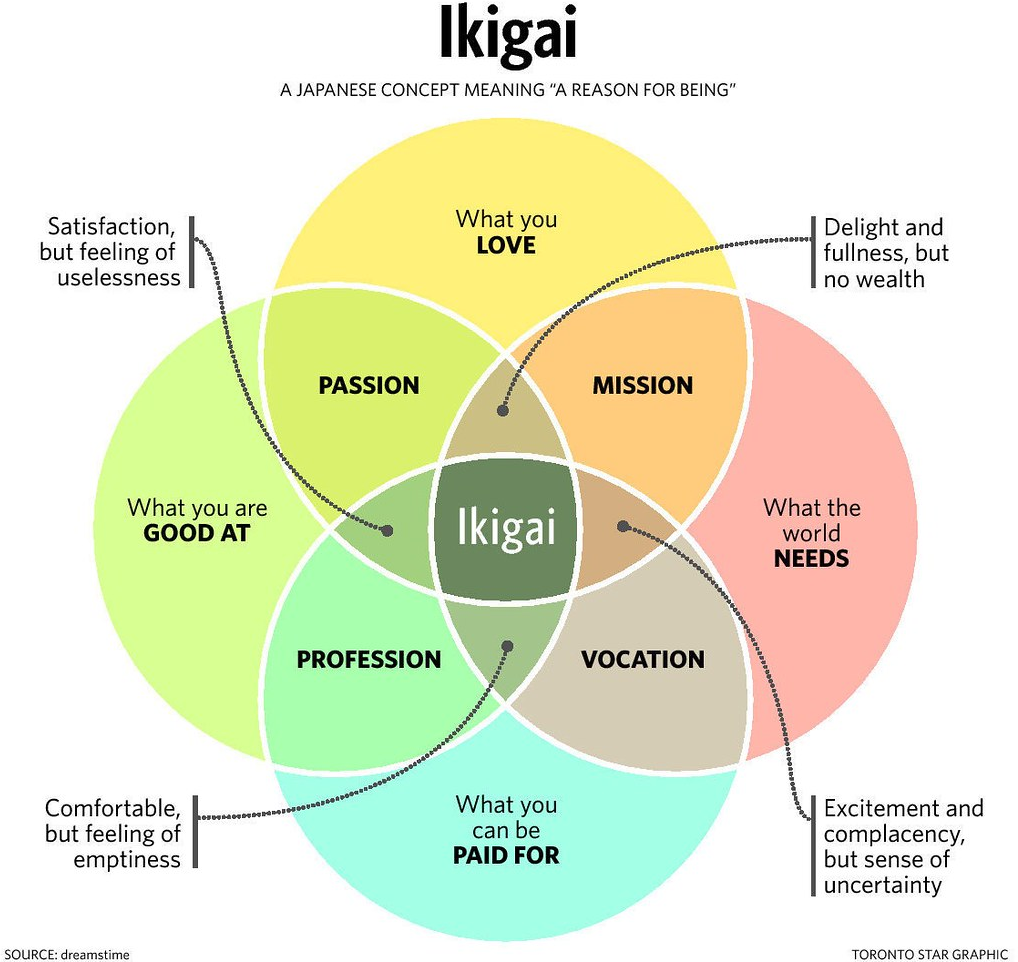
The next part of our call was to do our own version of an Ikigai. We then shared these with each other.
So much of mine was pointing towards teaching and helping others, it was a bit scary but also very true. I do feel that I am probably very lucky to be absolutely passionate about what I do and never feeling I don't want to go to work. I love teaching and I love creating and helping, it's my work, my passion and my mission.
Doing this brought me a bit closer to what I want to do for my project - I'm going to flesh it out a bit more but it comes back to supporting diverse learners again and again.

We then had a discussion about what the rest of our year might look like as Boma Fellows. We are going to catch up more frequently but for less time and we still get to do an online workshop with David Clifford from the Stanford d.school on Liberatory Design Thinking which I am really looking forward to!
Time to get into more planning of my project...

Monday, 2 March 2020

Boma NZ Education Fellows February

Wow. We had our first full day workshop this weekend. It was fantastic. Such a great day and I learnt a lot about a lot of things, always a good sign.
We met out at the airport in the Digital Innovation Zone in the Domestic Terminal. It is fascinating that even though I have been to the domestic arrivals area many times, I have never turned around and seen this space. It's got some cool things in it, so have a look next time you are waiting for those passengers to arrive!
Anyway, we were introduced to our speakers, told we would be solving a problem by creating a physical product related to neurodiversity in education and then we split into teams. Each person in the team then had to write an adjective on a sticky note and a plural noun on another sticky note. We then used these to come up with our team names. The three teams were then decided - Confused Shoes (my team), Confused Grasshoppers and Delicious Mongooses.

Geoff Brash from GBJ Innovation


Geoff went through what a startup was and told us that it depended on who you were to what it meant to you. We came up with a few ideas and he talked us through this model. Some of the things present in a startup are:
Scalability - Growing - Innovation - Sustainable business model - Big opportunity - Passion & uncertainty
We had a short discussion on what it is to each of us.

Katrina Beresford - Neurodiversity

Katrina did a presentation for us about neurodiversity. She told us that about 10% of our students have divergent needs, some high, some low. She went through this amazing infographic and talked about labels and about how we should be focussing on the strengths of these students. It is really important for wellbeing and our living standards framework is not always deliberate in classrooms. We want people to know what it is like to fill out a from and give them  opportunities to succeed in later life. If we are inclusive, what does that look like? Think about health care and education - what can we do to change that?


Bree Fick - 

BreeFick.com
Bree started the process for the day by talking to us about Design Thinking. It is an iterative process and you have to put any assumptions aside and look at the end user.
She introduced us to the Periodic Table of Design Thinking which has some good ideas on it. She talked about how Google asks its employees to get up and interact with others. The tools we would learn today we can take into our own projects. These are my notes from the rest of the day.

Empathise (wide focus)
Listen to the end user, get into their environment and experience it with them. Collect info, sometimes an information overload. Find out more about the problem through observing, engaging and empathising with people to understand their experiences and motivations, as well as immersing yourself in the physical environment so you can gain a deeper personal understanding of the issues involved. Empathy allows you to set aside your own assumptions about the world in order to gain insight into users and their needs.
Define (close in)
Analyse that information, get really clear then pick what is important. Close in on what you want to solve. Analyse your observations and synthesise them in order to define the core problems. Seek to define as a problem statement in a human-centred manner. Progress to ideation by asking questions which help you look for ideas for solutions by asking “How might we…"
Ideate (wide)
Get as many ideas as you can. Quantity over quality. Best ideas come from empathy mindset, role play, get into their head. Think outside the box to identify new solutions to the problem statement you’ve created and you can start to look for alternative ways of viewing the problem.
Prototype
Make something tangible so you can put it in front of the end user. For example the Google glasses prototype. Produce a number of inexpensive, scaled down versions of the solution or specific aspects of the solution. This is an experimental phase, and the aim is to identify the best possible solution for each of the problems identified during the first three stages. By the end of this stage, you will have a better idea of the constraints inherent to the solution and the problems that are present, and have a clearer view of how real users would behave, think, and feel when interacting with the end product.
Test
Validate assumptions and prototypes. Pivot - if it's not working, move away quickly. Here you rigorously test the complete product using the best solutions identified during the prototyping phase.

All the way through you have assumptions and need to pivot.
There are lots of tools in each section, it's not linear. Project based learning is similar, enabling students to solve a problem. There is a process that sits under that.

Our job was to identify the end user for our project today, then create the physical prototype.

We need to see the red flags on our databases as star signs, not flags.
We thought about our end users for our problem. Who are the people present in the conversation? Parents, teachers, students, Ministry, RTLB, BoT, our own children?
Our groups then got together and talked about what we might like to work on for the day. We did a Design6 activity where we quickly put down 6 ideas that we might like to work on, if money was no object, we had 10,000 people to work on it, and we could remove any obstacles in our way. Once we had those, we worked together in our teams to decide on an idea to follow through with. We looked at the SCAMPER technique for creative thinking as well, which was great for us to sort through the ideas.
Substitute What would happen to the project if we swapped X for Y?
Combine What would happen to the project if we combined X and Y?
Adapt What changes would need to be made to adapt this project to a different context?
Modify What could we modify to create more value on this project?
Put to another use What other uses or applications might this project have?
Eliminate What could we remove from the project to simplify it?
Reverse How could we reorganize this project to make it more effective?

We then went through the design thinking process throughout the day.

Define the problem
Our team decided that we wanted to help teachers in the class to understand their students in the classroom. We wanted to get them to use their strengths, rather than focus on their weaknesses.
We were taken through a Design Thinking Canvas, which covers:
Purpose/Vision, Problem, Solution, Unique Value Propositions, Stakeholders, Early Adopters, Promotion channels, Alternatives, Measurement, Resources, Financial sustainability, Cost, Educational Value and Impact. Lots to think about!!

I had an idea about giving teachers a "day in the life of" so they could experience what it was like to be a neurodiverse learner. We reframed this a few times, looking at different ideas of how it might work and then we went to work following the process.
We discussed the spiky profile that many students have and how we should be modifying a task with neurodiverse in mind.

Geoff took us through a session about user validation and explained about the different types of people to get involved. He showed us the Diffusion of Innovation model and went through each stage, from the Early adopters who like to improve things and are excited about change, to the Laggards who need convincing.
He talked us through the 5 steps that Steve Blank, a startup expert, said that the early adopters need.
1. Has the problem
2. Is aware of having the problem
3. Has been actively looking for a solution
4. Has put together a solution out of piece parts
5. Has or can acquire a budget
Getting further down the list is better. If you can find people who have already tried things then together you may be able to use it. Early adopters need need to try things early and give you feedback on your idea. You need to identify the people that are most excited to work with you on a project. How do you find them? Hopefully they have voiced the problem before. Part of the challenge is asking the right questions. If you are looking for decision makers, they may not be a 5, maybe a 2, but then you need a range of people.

Rapid Prototyping
You need to do this early on. Issues come up.  Need to prototype all three:
1. Comparison - is it better round, square or triangular?
2. Testing - Does it actually work?
3. Funding - investors aren’t always good at using their imagination

Testing and Product Validation
Find evidence. A lot of things we say one positive only eg this thing worked as opposed to this thing worked for one person and might work for a class.
Do interviews first and questionnaires later. You should know what sort of answers you are looking for in a survey, do 60 and prove you are right. Observations in education are critical.
Validation issues - people are nice. They will answer nicely, people won't say they don't understand, they'll nod instead.
Interviews - don't just ask friends, ask a range of people. Talk to early adopters and qualified people.
Don't use leading questions. You can't ask if they have the problem. Find people and ask what their biggest challenges are.
Look at indirect indications - things they do that give you information. If they do an activity without prompting it tells you something about them. Look at the full picture.
Asking questions in an interview: Ask them their key challenges. If it doesn't come up in their top 3, it probably won't be a focus for them. Ask "when did it last happen". You can guide - "when you say curriculum, what is on top for you there". Ask "how are you currently solving that problem".
Try and lead as little as possible.
Always go back to the problem and early adopters - who will use it. Investors want to see measures and results.
In choosing our own projects: Make sure it is meaningful to you and to those who care. Passion. Which one do you need to shut up about to your friends?

We then spent quite a bit of time going through the process for our team projects for the day. The "Confused Shoes" worked hard and we came up with some great ideas in the short time we had.

Mentors
The next session was about mentors for our personal projects for the year. They talked about the types of mentors we could have:
The coach - Someone who has A LOT of industry experience, willingness to sit down and talk you through things often.
The connector - Someone who is well-connected and willing to open up their network to you. Social butterflies.
The cheerleader - Someone who encourages you, always on your side, you can count on them when times are tough to cheer you up. The challenger - Someone who tells it like it is, trusted person to deliver bad news, honest, and open communicator.

Ideally we should look for a range of types and then learn what to do BEFORE meeting with them. Know the expectation - do we want to connect, get finding, resources? Know what they do in their organisation so we don't waste their time. Send an agenda if we want.

How to find them:
 ● Who do you admire that you’d like to meet?
● Who else is going through what you’re going through?
● Who leads companies you admire?
People are more accessible than you think. Don’t be afraid to ask for a meeting with someone important but make sure you make it worth their time

We then had to come up with 3 questions we wanted to ask our mentor for the day. We had a couple of people to talk to and we came up with these questions:
What would you need to convince you this would work/validation needed to believe in this product?
If this was your idea, how would you get it made and funded?
How could you see this being used outside the education sector?
Do you have any questions you think we should consider?

The answers we got were really helpful in the short time we had. Some of the feedback:
Need to know that people are committed to trials and providing data would be helpful.
Some companies to look into for AR/VR work - Jix, Henry Lane at Corvecto
Look at breaking the work into steps - first version, drop things out, make it really simple  - 1 scenario, 1 user rather than looking at the whole thing. Simulate AR/VR with video first.
Can you analyse projects around the country and recommend told already being used?
How much does each project need to be tested? Maybe we don't need the tool if it's already available.
We need to prove the concept first. Test without creating VR equipment, then use proven value to secure funding.
Who are the key stakeholders to approach for funding?
Look at industries with similar problems
How could we balance the +ve and -ve lens?
How much could we do with a website vs a VR experience? Prototype with a website first to see the value first. Prove the value in that.

Hints for meetings:
1. Show you’re serious and respectful of their time.
2. Pay attention to everything they say.
3. Remember you are talking to a real person.
4. Mention how they can be involved, specifically.
5. Determine next steps
6. Give back, offer your help, if applicable.
After meetings:
1. Follow up fast!
2. Be proactive with next steps.
3. Do all the work for them. Provide them with everything they need to make their job easy.
4. Stay on them. They are busy people but persistence pays off.

We spent some time prototyping our idea - as ours was based around a VR experience, you can see our prototype here!


Marketing
Who? Who has the purchasing decision? Who are your early adopters? Who is the logo/brand for?
What? What are the problems you’re solving for them? What is the core message are you trying to portray? What are the features and benefits? What feelings do you want to inspire?
Where? Social media: Facebook, Twitter, etc Website Print media: Education gazette, newspaper etc TV/Radio Word of Mouth
How? Tell stories, give stats and examples, paint a picture
Simon Sinek's Start with why

Pitching
Goal - in any conversation they won't remember much, so what are the three top things you want them to hear - repeat them.
Better to be simple and clear and ask questions than to be long.
Start with understanding - use the Canvas - problem/solution/customer

If you use a slideshow don't give set ones. Use a storyboard approach, set the scene at the beginning.
Be a better simple presenter than a worse complex one.
Demo depends on what you have already
Traction - talk about progress towards sales and customers
Testimonials - easy to get
If you ask for money, know what you will do with it
People need the logic (head) and the emotion (heart)

Today we had to make a 3 minute pitch to educators, asking for support.

Another couple of articles we read:
Neurodiveristy: A Competitive Advantage in Cybersecurity
Learning Difficulties 'link to brain connections'

Overall an amazing day. It was a long, tiring but extremely satisfying day. It was great to get to know a few more of the group and I enjoyed the chat time we had over breaks.
Thanks to all the presenters and to Boma and Christchurch Airport.What a great opportunity I have.